I am now halfway through my summer school placement with Boots, and learning more and more every day. Over the last couple of weeks I have had some challenging but constructive criticism, met last years summer school student and been to cover in a different store.
The great thing about the placement and the job is you never know who or what is going to walk through the door of your practice every day. The store I am at has a wide ranging customer base, lots of over 60's NHS patients (often with cataracts, glaucoma or another age related condition), to middle aged people who like the range of styles available, to people on benefits and children coming in for first few eye tests with a few emergency cases thrown in for good measure. Because of the wide range of customers it is important to be able to adapt your questioning style when doing check-ins and how you talk to customers when they collect glasses, I'm glad I've got 10 years retail experience as otherwise it can be very daunting.
I have started dispensing, just single vision at the moment, but everything has to start somewhere. Dispensing is that final stage in the customer's first visit to the store (second visit is collection) and the point when all the lifestyle questions and the recommendation from the optometrist all come together. This is when a good demonstration of all the upgrades is key, and whilst I haven't sold any yet I have done well with glasses cover. Whilst some people may see these upgrades as pushing unnecessary products to make money I have yet to see anyone promote anything that wouldn't be of use to a customer. I am really glad I can say that as pushy sales staff who slam customers with unnecessary products to hit targets or lie their own pockets really annoy me and I've seen a few.
Going to cover another branch was a good experience as it showed the consistency of approach throughout the company, even if the other branch did have an even more temperamental NCT than my usual one. Those things really are the bane of my existence at the moment. Port Talbot was small and quiet with just 2 of us and a locum in which was vastly different to Swansea with 2 optoms and about 6 of us on the shop floor. I made the most of it by having a look at other parts of the systems that I hadn't used before, like Glasses Studio, which I look forward to using soon.
Next week I have a visit to another Boots store planned, this time to see the links between a pharmacy and the opticians, and hopefully I will get a chance to speak to an audiologist as well so really see how the one health idea all comes together. I also look forward to dispensing multifocals, which at the moment seem a little daunting but then so did single vision before I did that.
Random musings of a optometrist as I meander my way through life.
Saturday, 28 June 2014
Monday, 16 June 2014
Week 1 thoughts
Last Monday I started a 6 week programme with Boots on their Future Optometrist Programme. The scheme is designed to give students a flavour of retail optics and how Boots works in particular. It also acts as a 6 week interview from point of view of company and allows the student to get idea of whether Boots is right for them and how they get on with the staff where they may well be working on the pre -registration year (pre-reg for short).
My placement is in Swansea so involves a nice little train journey in the morning, although this gives me a chance to catch up on TV or books I've missed out on and catch a nap if needed.
The first impressions were good, the store is reasonably well equipped and more importantly the staff are really friendly and seem to put up with all the random questions I've been throwing at them all week. It's very strange for me to not know anything about the system or how anything works, after doing the same job for over 10 years I've worked out exactly how the systems in my current job work.
Although I had received and read the student guide to the programme I was a little surprised about doing so much work as an optical consultant and it wasn't until I went to the introductory conference in Birmingham on Thursday which put the programme into context. I'd been thinking too literally that it was all about optometry but it isn't; the optometrist is not alone - they are working as part of a team and to understand the team you need to understand the other roles. To this end I have been welcoming patients into the practice, answering the phone, adjusting glasses, running though collections, making appointments and helping with pre-screening. The amazing thing is that this isn't all optical consultants have to do; there is extra paperwork for NHS and PEARS forms, asking lifestyle questions as part of pre-screening to aid the 3 moments of truth, helping with referrals, managing emergency patients, checking in glasses and of course dispensing, with the aid of a dispensing optician for tricky dispenses. I apologise to all optical consultants and assistants I may have unwittingly looked down on, they have a vital role to play and put in a lot of hard work to ensure the branch runs smoothly.
The highlight of the week was the welcome conference in Birmingham on Thursday. This highlighted Boot's purpose "We commit to enrich the life of every person. We are a health led optician, yet care about a whole lot more." It also highlighted the 3 moments of truth which are used within the customer journey to ensure the customer gets the best possible service. I look forward to seeing the results from the customer metrics and working out ways to improve them, over the next few weeks.
I had my first review on Saturday which was a bit nerve wracking, I was confident I had done okay but am always worried that there is something I've done wrong or missed. However it passed without a hitch, I got some good feedback and a plan for the next few weeks is developing so I am looking forward to the rest of the placement, if not the early starts.
Saturday, 7 June 2014
End of second year musings
So walked out of final exam on Tuesday and it felt like a great weight had been lifted from my shoulders. The first years looked a little confused as to what had just happened, but that's normal after a dispensing exam whilst the third years were a mixture of elated that they had finished and disbelief that they had finished.
Library books went back on Thursday and it was time to relax for a little while before I start my summer placements on Monday - no rest for the wicked. I'm doing two placements with Boots first and then Specsavers so it will be interesting to see how the two compare.
So what have I learned over the last year:
Contact lenses are interesting, the materials aren't that much fun (although tours round factories are) but there is so much you can do with them to help patients in a slightly different way from normal spectacle use. There is a big market out there that can really help businesses but at the same time there are risks that need to be managed.
Pharmacology offers a lot of further training paths that I may well want to explore later on in my career but there is a lot to learn for exams about drugs, doses, uses, contraindications, side effects... This made it one of the most engaging courses of the year but also one of the scariest exams.
Binocular vision really isn't that scary, maybe it's because one of my friends has a squint so I am so used to testing them that it doesn't throw me off from usual routine. Yes there are a lot of conditions that need to be managed especially in young children but if you know the risks you know what needs to be done.
Neurophysiology is a bit of an odd one, whilst I can see the uses of some of it in practice particularly the links with visual fields and agnosias, not sure how much of it I will use in future, likewise with perception.
Colour vision seems to be remarkably easy, and visual fields is useful. The main thing to remember from visual fields is that the answer isn't always glaucoma but there is a pretty good chance it is.
So lots to take forward and look forward to starting third year in a few months. Now just need to go back to waiting for exam results. Fingers crossed.
Library books went back on Thursday and it was time to relax for a little while before I start my summer placements on Monday - no rest for the wicked. I'm doing two placements with Boots first and then Specsavers so it will be interesting to see how the two compare.
So what have I learned over the last year:
Contact lenses are interesting, the materials aren't that much fun (although tours round factories are) but there is so much you can do with them to help patients in a slightly different way from normal spectacle use. There is a big market out there that can really help businesses but at the same time there are risks that need to be managed.
Pharmacology offers a lot of further training paths that I may well want to explore later on in my career but there is a lot to learn for exams about drugs, doses, uses, contraindications, side effects... This made it one of the most engaging courses of the year but also one of the scariest exams.
Binocular vision really isn't that scary, maybe it's because one of my friends has a squint so I am so used to testing them that it doesn't throw me off from usual routine. Yes there are a lot of conditions that need to be managed especially in young children but if you know the risks you know what needs to be done.
Neurophysiology is a bit of an odd one, whilst I can see the uses of some of it in practice particularly the links with visual fields and agnosias, not sure how much of it I will use in future, likewise with perception.
Colour vision seems to be remarkably easy, and visual fields is useful. The main thing to remember from visual fields is that the answer isn't always glaucoma but there is a pretty good chance it is.
So lots to take forward and look forward to starting third year in a few months. Now just need to go back to waiting for exam results. Fingers crossed.
Saturday, 17 May 2014
Dissertation thoughts
First off, sorry for not updating this for a while, I've been busy with revision as it's exam season which is typical just as the weather improves. I've also started blogging for the university undergraduate team, you can read my uni based thoughts and those of fellow students here.
So far I've had one exam on Tuesday which I think went okay but just need to wait and see. Two more coming up this week.
The other major thing that happened this week was that we were given the methods of choosing our dissertation and the range of possible titles there are. The method of selection is a little complicated but at least we have an element of choice over what we get rather than just a complete lottery. The topics range from some that interest me immensely, to ones that I would prefer not to touch with someone else's 10 foot barge-pole. Without wanting to curse things and get my hopes up there are some titles that play to my strengths and interests from outside optometry and some that I don't even understand the title of. Still I have 2 1/2 months to try to put together a list of preferences and then have to wait until October to actually find out what I've been given.
I'm excited to start writing it but at the same time a little apprehensive about how much work is involved, it's been over 10 years since I last did a research project, did two in last degree, and didn't particularly enjoy them. The other thing that scares me is how quickly time it passing, it doesn't seem like a year since I was chatting with the then 2nd years about how early they were choosing their titles and it means I am coming towards the end of my course :-(
So far I've had one exam on Tuesday which I think went okay but just need to wait and see. Two more coming up this week.
The other major thing that happened this week was that we were given the methods of choosing our dissertation and the range of possible titles there are. The method of selection is a little complicated but at least we have an element of choice over what we get rather than just a complete lottery. The topics range from some that interest me immensely, to ones that I would prefer not to touch with someone else's 10 foot barge-pole. Without wanting to curse things and get my hopes up there are some titles that play to my strengths and interests from outside optometry and some that I don't even understand the title of. Still I have 2 1/2 months to try to put together a list of preferences and then have to wait until October to actually find out what I've been given.
I'm excited to start writing it but at the same time a little apprehensive about how much work is involved, it's been over 10 years since I last did a research project, did two in last degree, and didn't particularly enjoy them. The other thing that scares me is how quickly time it passing, it doesn't seem like a year since I was chatting with the then 2nd years about how early they were choosing their titles and it means I am coming towards the end of my course :-(
Wednesday, 16 April 2014
The Eyeball
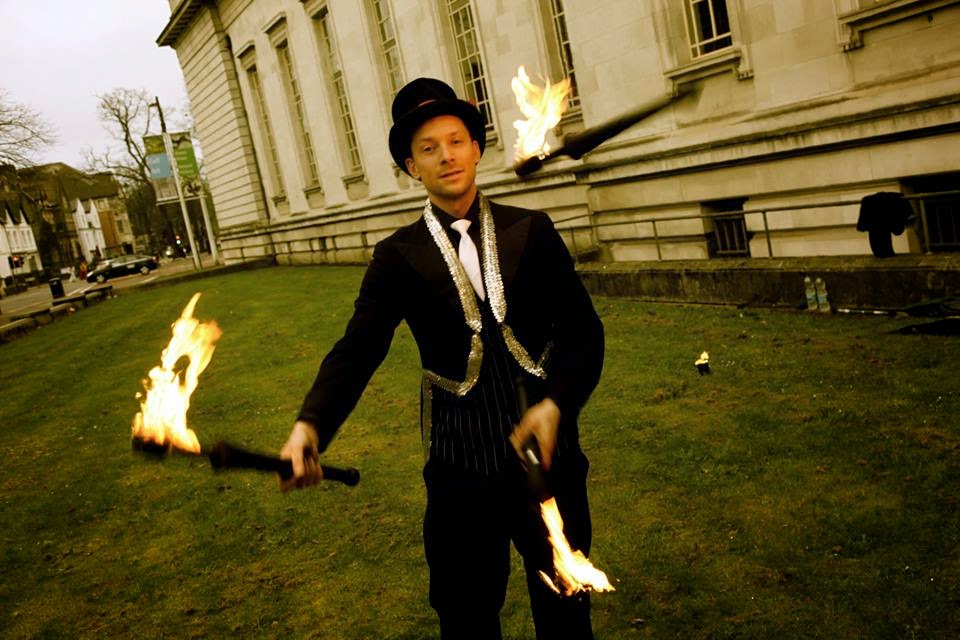
After a hectic couple of weeks with practical exams and resits (resit passed, fingers crossed on the other practicals) it was time for Cardiff to let its hair down with the annual Eyeball. Other universities may hold them but Cardiff is the biggest and the best. This year it was held at the National museum. As people turned up they were greeted by fire breathers and jugglers.
After a drinks reception, where I didn't get a drink, we headed out onto the balcony to see the tables all set up below with a carnival theme, so we walked down past a coconut shy, test of strength and picked up some popcorn and candy floss to keep us going until food arrived.
Food was a lovely leek and potato soup followed by a stuffed chicken breast and then a chocolate cheesecake which was very nice, I could easily have eaten another portion (or two or three) of that.
After that it was time for the raffle, I didn't win anything but it did raise lots of money for charity, the awards - some funny and some serious before it was time to reveal who had won the elections and would be the faces of OPSOC for the next year. I was lucky enough to be re-elected as treasurer so will be in charge of the purse strings for another year. Well done to everyone else who was elected and commiserations to those that weren't.
After that it was time to party the night away first at the museum and then onto the after party at Tiger Tiger. At half two it was time to go home to bed, and I was glad I had booked the following day off work.
Wednesday, 2 April 2014
Open day fun
Today was a university wide open day so I was helping out by taking prospective students round the building, showing them where Doctor Who and Sherlock were filmed (see here for Dr Who); answering questions; using a slit lamp and demonstrating simulation spectacles which simulate the wearer having various optical conditions like glaucoma or cataracts.
Optometry tends to be a lesser known subject and because we are little away from the main campus we don't get a massive number of people but it does mean that the ones we do get are generally interested in the subject or at the very least thinking about it. Prospective student open days are a little different from offer open days in that you need to convince the student that optometry is the career and course for them rather than convincing them that Cardiff is the best place to study the subject. This requires a slightly different approach but the main similarity is to just be friendly and talk to everyone. If you can't do that then optometry possibly the subject for you anyway.
I always enjoy helping out with open days as I know I didn't know what I wanted to do the first time I went to university. Having a look at different options and seeing what people think of the course and whether you could see yourself in their shoes is a great help in my opinion.
Optometry tends to be a lesser known subject and because we are little away from the main campus we don't get a massive number of people but it does mean that the ones we do get are generally interested in the subject or at the very least thinking about it. Prospective student open days are a little different from offer open days in that you need to convince the student that optometry is the career and course for them rather than convincing them that Cardiff is the best place to study the subject. This requires a slightly different approach but the main similarity is to just be friendly and talk to everyone. If you can't do that then optometry possibly the subject for you anyway.
I always enjoy helping out with open days as I know I didn't know what I wanted to do the first time I went to university. Having a look at different options and seeing what people think of the course and whether you could see yourself in their shoes is a great help in my opinion.
Tuesday, 18 March 2014
Coopervision tour
A couple of weeks ago, I was lucky enough to go on a trip with some fellow students to the Coopervision manufacturing centre near Southampton.So after getting up at the crack of dawn, the coach left at 8am, we were on our way.
When we got there, after a slight delay on the M4, we were treated to some nice pastries (I may have eaten quite a few) and a short talk from Mark, a member of the professional services team who had helped arrange the trip, about the company and how lenses are made.
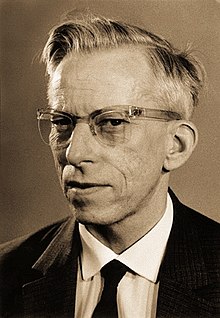
The first soft hydrogel contact lens was manufactured by Otto Wichterle in 1961 using a spin casting machine made from Merkur, a Meccano type kit. After patenting the process he was able to make 5500 in the first few months, before the licence to the patent was sold without his knowledge to the USA.
There are currently 5 main methods of contact lens manufacture:
When we got there, after a slight delay on the M4, we were treated to some nice pastries (I may have eaten quite a few) and a short talk from Mark, a member of the professional services team who had helped arrange the trip, about the company and how lenses are made.
The first soft hydrogel contact lens was manufactured by Otto Wichterle in 1961 using a spin casting machine made from Merkur, a Meccano type kit. After patenting the process he was able to make 5500 in the first few months, before the licence to the patent was sold without his knowledge to the USA.
There are currently 5 main methods of contact lens manufacture:
- Spin casting - still used mainly by Bausch and Lomb
- Lightstream technology - used by Alcon which uses UV light to cure the monomer
- Lathing - old fashioned method, mainly used for rigid gas permeable lenses
- Hybrid - a Coopervision exclusive with front surface moulded and back surface lathed
- Cast moulding - main technique used for mass production of soft contact lenses
The first stop for my group was a trip round the DK128 Biofinity manufacturing process, or part of it anyway, so after getting dressed up in a funky gown, hat, shoe covers and static strips we were allowed in. There we were shown some of the 12 operating lines that manufacture over 250-280,000 lenses between them every 12 hours, with each line only needing 10 people, several robots and a giant sunbed - a long tunnel lit by UV light to help set the monomer and remove impurities.
One interesting fact that came up from this part is that due to the use of colour to help track batches and individual cavities within each batch people with colour vision defects can't work in this section of the business.
After a tasty lunch, including more cake, it was time for a trip round the second part of the factory, the lathing section. In here we got to see how a button of monomer is lathed down to a thin RGP or in the case of the new hybrid methods, half moulded and half lathed. This is a slower (and more expensive) method but better for RGP and allows tints to be applied and for a very particular level of quality control. The production rate can vary between 20 and 5000 per day depending on the method and order. A custom order can be made and sent out in as little as 2 days.
We then had a talk about the summer scholarship programme, the values of the company - dedication, inventive, partners and friendly and got to here the opinion of the UK MD of manufacturing. He believes that the factory will increase production from 1.6 to 2.5 million within the next 3 years and that the market is moving more towards silicone hydrogel as this becomes feasible for daily disposables, and that drug dispensing and smart lenses will be a niche market. (I'm not so sure about this last point, I believe there is a large potential there and can see it growing as the technology develops). A quick run through some of Coopervision's lens technologies including Proclear for dry eye and presbyopic patients and multifocal lenses and it was time to go home (with extra cakes and goody bags).
After a quick trip home I was lucky enough to wind up with all the spare cake, so all it leaves me to do is thank our hosts; Mark, Lee, Ben, Carly, Elaine, Tracy and Steve for their time and for organising the trip. I found the trip fascinating seeing how a liquid polymer is transformed into a thin lens that we put into a patient's eyes.
In the last couple of weeks I have had the opportunity to use the Coopervision Biofinity lenses that we saw made, okay not the exact same ones but you get the idea. The lenses were fairly easy to insert, even with my kack-handed insertion skills; and whilst I only occasionally wear coloured lenses (joys of being emmetropic) but found the Biofinity very comfortable for the short period I had them in. It will be really interesting to try them with real patients next year and compare what they found to what I found. At least now if a patient asks how lenses are made I can give them a full answer, knowing me probably more than what they want.
Subscribe to:
Posts (Atom)